Interstate 8

Return to AARoads


Site Navigation
Baja California
California
Colorado
Idaho
Hawaii
Nevada
New Mexico
Oregon
Utah
Washington
Wyoming


Business Loops from Interstate 8

Interstate 8 Highway Guide/Links

Business Loop 8 - San Diego and La Mesa

Business Loop I-8/Washington Street and Historic U.S. 80 (1947-1953) east
The business loop for Interstate 8 begins at the intersection of Ninth Avenue and Washington Street. Incoming traffic from southbound California 163 (Cabrillo Freeway) connects to Washington Street via an offramp that links directly to Ninth Avenue. Prior to 2002, this business loop was well-signed through the University Heights and North Park communities of San Diego, but most of the shields were removed. A lone post (adjacent to white guardrail fence) used to carry a business loop shield, but that shield is now gone. Photo taken 10/29/05.
A pedestrian bridge, which serves as the continuation of north-south Vermont Street, provides access over Washington Street. Photo taken 10/29/05.
The next intersection along eastbound Washington Street is the ramp to California 163, which is former U.S. 395. This ramp provides access to both directions of California 163. From here eastward, Washington Street follows the 1947-1953 alignment of U.S. 80, which was renumbered as Business U.S. 80 after U.S. 80 was moved to the Mission Valley Freeway. In 1964, Business U.S. 80 was renumbered as Business Loop I-8. Photo taken 10/29/05.
This ramp originally connected U.S. 80 with U.S. 395 when the Cabrillo Freeway was constructed in 1947. Prior to 1947, U.S. 80 followed Park Boulevard south to Market Street, then turned west on Market Street to end at U.S. 101 (Harbor Drive). From 1947 until 1953, U.S. 80 traveled further west along Washington Street, transitioned onto U.S. 395 (Cabrillo Freeway) south, then followed the 10th Avenue and 11th Avenue one-way couplet to Market Street in downtown San Diego. From 1953 to 1972, U.S. 80 followed the Mission Valley (Alvarado) Freeway, which is today known as Interstate 8. Photo taken 10/29/05.
Washington Street was constructed before it became part of U.S. 80. The concrete here likely dates from the city's construction of the roadway, not state construction. This traffic signal is for Lincoln Avenue, which travels east into North Park. Photo taken 10/29/05.
At this traffic signal, Washington Street comes to its western terminus. The business loop turns to the northeast along Normal Street for a couple of blocks. Photo taken 10/29/05.
Business Loop I-8/Normal Street and Historic U.S. 80 (1947-1953) east
The next intersection is with Park Boulevard, which is the point where U.S. 80 and U.S. 395 used to travel south toward Balboa Park and downtown San Diego before the completion of the Cabrillo Freeway in 1947. Continue straight ahead to continue east along Business Loop I-8 to El Cajon Boulevard. Photo taken 10/29/05.
Normal Street reaches its northern terminus as it transitions directly onto El Cajon Boulevard eastbound. Park Boulevard travels north into University Heights. To the south, the original U.S. 80 and U.S. 395 alignments travel south through Balboa Park past the World Famous San Diego Zoo into downtown San Diego. Proceeding east, El Cajon Boulevard is a very historical route that was bypassed when the Mission Valley (Alvarado) Freeway (today's Interstate 8) opened in 1953. Businesses along El Cajon Boulevard suffered as traffic flowed through Mission Valley rather than North Park, but that has changed in recent years. Redevelopment, new residential projects, and a renewed interest by many to live in urbanized neighborhoods rather than suburbs has revitalized El Cajon Boulevard and promises many positive changes still to come. Photo taken 10/29/05.
U.S. 80/El Cajon Boulevard and Business Loop I-8 east and U.S. 395 north
After the Park Boulevard intersection, eastbound U.S. 80-395/El Cajon Boulevard approaches the historic "The Boulevard" sign (dedicated in 1989 and designed to remind people of the Boulevard's colorful, neon past from the 1950s). The two U.S. highways shared alignment on El Cajon Boulevard between Park Boulevard in University Heights and Fairmount Avenue in City Heights. At that point, U.S. 395 turned north on Fairmount Avenue, while U.S. 80 continued east on El Cajon Boulevard toward La Mesa and El Cajon. Photo taken 05/15/08.
The giant, art-deco, neon, illuminated Boulevard sign greets travelers entering this long-standing commercial district. The text on the sign below the large words "The Boulevard" reads: "El Cajon Boulevard: Gateway to Mid-City." As one of the main streets of San Diego, travelers entering the city could find all sorts of shops, restaurants, and lodging along El Cajon Boulevard. From here, Business Loop I-8 (still unsigned) follows a six-lane alignment, with three lanes in each direction and a wide, landscaped median. U.S. 80 followed El Cajon Boulevard between 1926 and 1953, while U.S. 395 followed this alignment for a shorter period (the designation was transferred to the Cabrillo Freeway in 1947). This sign was dedicated in 1989. At this point, U.S. 80-395/El Cajon Boulevard passes through University Heights and enter North Park. Photo taken 10/29/05 and 05/15/08.
Purple blooming jacaranda trees line the landscaped median strip as eastbound U.S. 80/El Cajon Boulevard meets Florida Street at this intersection. Turn south to follow Florida Street to Balboa Park and Florida Canyon. Florida Street is a major north-south corridor that connects North Park with Balboa Park and Florida Canyon. After passing through the canyon, Florida Street ultimately connects with Pershing Drive near Golden Hill. Photos taken 10/29/05 and 05/15/08.
Another U.S. 80 historic sign is posted in front of the Lafayette Hotel near the Red Fox Room prior to the Texas Street intersection. Photo taken 05/15/08.
Many of the streets that intersect El Cajon Boulevard in North Park are named after states rather than being numbered. The first street after Park Boulevard (equivalent of 18th Street) was Georgia Street, followed by Florida, Alabama, Mississippi, and Louisiana Streets, in sequence. Here the boulevard approaches Texas Street, which is the equivalent of 24th Street. Texas Street offers a direct route to shopping areas in Mission Valley, and it also interchanges with Interstate 8 to the north. Texas Street changes into Qualcomm Way (formerly Stadium Way), which ends at Friars Road west of Qualcomm Stadium. Photo taken 10/29/05.
Eastbound U.S. 80-395/El Cajon Boulevard meets Texas Street at this intersection. Turn north to follow Texas Street into Mission Valley; turn right to the northern edge of Balboa Park at Morley Field. The U.S. highways continue with three through lanes of traffic in each direction, plus parking and auxiliary turn lanes. Note that the landscaped median that was under construction in 2005 was completed by 2008. Photo taken 05/15/08.
A tall eucalyptus tree sits at the southeastern corner of El Cajon Boulevard and Arizona Street, which is one block east of Texas Street. Photo taken 05/15/08.
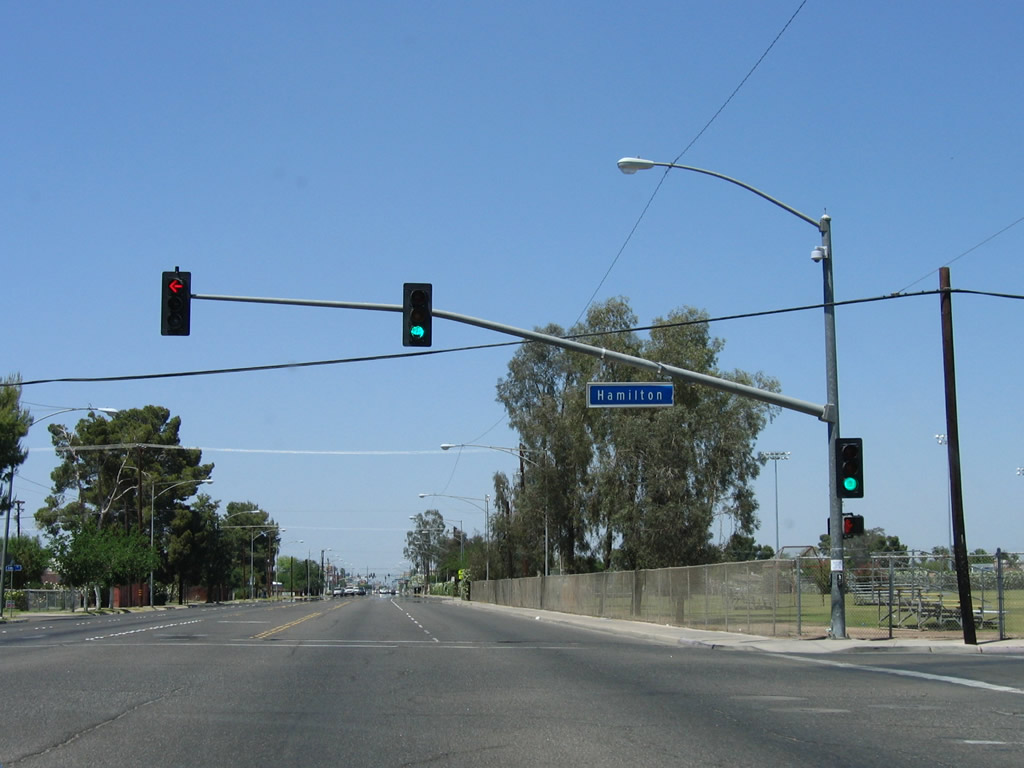
Eastbound U.S. 80-395/El Cajon Boulevard meets Hamilton Street at this intersection. Photo taken 05/15/08.
As seen in the last several pictures, the cross streets are mostly named after states. However, Hamilton is the exception (from west to east over five blocks, we pass Texas, Arizona, Hamilton, Oregon, Idaho, and Utah). This picture shows eastbound El Cajon Boulevard at Oregon Street just a couple blocks north of the North Park Community Park. Ample parking for this park is available along Oregon Street south of Howard Avenue. Photo taken 10/29/05.
At this traffic signal, U.S. 80-395/El Cajon Boulevard east meets Oregon Street. Turn south here to North Park Community Park. Photo taken 05/15/08.
One block east, U.S. 80-395/El Cajon Boulevard next approaches Utah Street, followed by Kansas Street. Photo taken 05/15/08.
Utah Street is the next major intersection, and it acts as a connector between University Avenue to the south and Adams Avenue to the north. El Cajon Boulevard continues east toward Normal Heights. Photo taken 10/29/05.
After passing Kansas Street, the next traffic signal is with 30th Street. This is the first numbered street encountered since passing Ninth Avenue near the California 163 interchange. Thirtieth Street is a major commercial corridor. Follow it south to downtown North Park and visit the historic North Park Theatre along the south side of University Avenue just west of 30th Street. Photo taken 10/29/05.
Eastbound U.S. 80-395/El Cajon Boulevard meets 30th Street at this intersection. Turn south (right) to downtown North Park; continue straight ahead to the junction with Interstate 805. Photo taken 05/15/08.
The last three state name streets intersected by El Cajon Boulevard eastbound are Ohio, Illinois, and Iowa. This small median sign advises of the pending Iowa Street intersection, even though no other intersections were labeled in that manner. The next traffic signal is for Interstate 805 (Jacob Dekema Freeway). Photo taken 10/29/05.
Interstate 805 is a major commuter freeway, acting as an alternative to Interstate 5 between the International Border with Mexico and Sorrento Valley. It acts as a boundary between North Park and Normal Heights. In fact, this boundary is also the historical boundary between the city of San Diego and the former city of East San Diego. East San Diego was annexed into the city of San Diego in 1923. The frontage road to Interstate 805 is named Boundary Street, which used to delineate the boundary between these two cities. This first traffic signal provides a connection to southbound Interstate 805. Photo taken 10/29/05.
After crossing over Interstate 805, the next traffic signal is a double left turn onto northbound Interstate 805. Interstate 805 offers a fast connection to Mission Valley via Interstate 8. It is also the best way from North Park to points north, including Del Mar, Oceanside, and Los Angeles via Interstate 5. Photo taken 10/29/05.
Continuing east, Business Loop I-8/El Cajon Boulevard (old U.S. 80) finally encounters its first reassurance shield some 26 blocks east of the western terminus at Ninth Avenue. This traffic signal is for 35th Street, which travels north through Normal Heights to Adams Avenue but does not descend into Mission Valley. Photo taken 10/29/05.
For the next several blocks, El Cajon Boulevard passes through a commercial strip with a wide variety of services. Pedestrian traffic for patrons of these establishments is common. Photo taken 10/29/05.
After 37th Street, U.S. 80/El Cajon Boulevard passes by a school, then approaches its junction with California 15 (Escondido Freeway). Photo taken 10/29/05.
California 15 is a major north-south freeway that begins in Barrio Logan to the south and transitions into Interstate 15 in Mission Valley to the north. From there, Interstate 15 travels north and east toward the Inland Empire and Mojave Desert, passing through Corona and Ontario en route to Victorville, Barstow, Primm, and Las Vegas. The freeway continues northeast through Mesquite to Utah and points north. Photo taken 10/29/05.
Use California 15 south to Interstate 805 south and to California 94 (Martin Luther King, Jr. Freeway). San Diego's only cut and cover tunnel is located along California 15 one block south of El Cajon Boulevard, between Orange Avenue and Polk Avenue. Photo taken 10/29/05.
The Mid-City Transit Gateway, which includes a transit center, pedestrian walkway, and future snack shop, is located on the bridge that carries El Cajon Boulevard over California 15. The freeway is below grade in a trench, while El Cajon Boulevard remains at street level. Plans call for a trolley line to be constructed along the median of California 15 at some undefined point in the future, and the Mid-City Transit Gateway would offer connections from El Cajon Boulevard if this trolley line is ever built. Photo taken 10/29/05.
The next traffic signal is for California 15 north. Follow California 15 north past the Adams Avenue exit to connect with Interstate 8 in Mission Valley. Photo taken 10/29/05.
Entering the Talmadge neighborhood, U.S. 80/El Cajon Boulevard passes Copeland Avenue. The business route continues to have commercial characteristics, and it is still six lanes wide. The boulevard will constrict to four lanes total after passing by the Fairmount Avenue/43rd Street one-way couplet. Photo taken 10/29/05.
Fairmount Avenue is one of the old alignments of U.S. 395. The original routing of U.S. 395 (1935-1938) started at the intersection of U.S. 101 (Morena Boulevard) and Linda Vista Road. It then turned northeast along Linda Vista Road, joining the Interstate 15 corridor near Miramar. In 1938, U.S. 395 was rerouted again, and this alignment lasted until the opening of the Cabrillo Freeway (current California 163) in 1947. On the 1938-1947 alignment, U.S. 395 started in downtown San Diego, followed U.S. 80 along Market Street, Park Boulevard, and El Cajon Boulevard to the Fairmount Avenue intersection. From there, U.S. 395 turned north on Fairmount Avenue, crossed the San Diego River via the Ward Road bridge, and followed today's Interstate 15 (former California 103) alignment through Murphy Canyon north to Miramar. So, during that ten-year period, the El Cajon Boulevard and Fairmount Avenue intersection represented the split between two major routes: U.S. 80 east to Georgia and U.S. 395 north to Washington. Photo taken 10/29/05.
U.S. 80/El Cajon Boulevard and Business Loop I-8 east
Still in Talmadge, eastbound Business Loop I-8/El Cajon Boulevard approaches Menlo Avenue. From here, El Cajon Boulevard gradually starts to turn a bit toward the northeast, crossing into the College Area community after 54th Street. Photo taken 10/29/05.
Prior to the signalized intersection with 59th Street, this Business Loop I-8 east shield was posted along eastbound El Cajon Boulevard. It is now gone. Photo taken 03/27/05.
This Business Loop I-8 shield is found along eastbound El Cajon Boulevard near the post office at Art Street in the College Area community of San Diego. This shield has seen better days, and apparently used to be an Interstate shield, complete with Montana as the state name! In this picture, it is clear that this shield has had another life elsewhere or was simply a misprinted shield that was reconditioned for use here. Photos taken 03/27/05 and 08/98.
Bypass U.S. 80 and Business Loop I-8/El Cajon Boulevard east
Business Loop I-8 and Bypass U.S. 80/El Cajon Boulevard west
The old alignment of U.S. 80 departs from Interstate 8 at the El Cajon Boulevard offramp in La Mesa. Also known as Business Loop I-8, El Cajon Boulevard mostly follows the original routing of U.S. 80 through La Mesa and San Diego, although the initial section of El Cajon Boulevard was built to bypass downtown La Mesa (La Mesa Boulevard follows Old U.S. 80's original route through downtown; it later became Business U.S. 80 and now is designated with Historic U.S. 80 route markers). Photo taken 10/08/10.
A single lane offramp connects Interstate 8 west with El Cajon Boulevard west. Photo taken 10/08/10.
It is implied that Historic U.S. 80 and Business Loop I-8 split left along El Cajon Boulevard. Exit right here for Center Street. Photos taken 10/08/10.
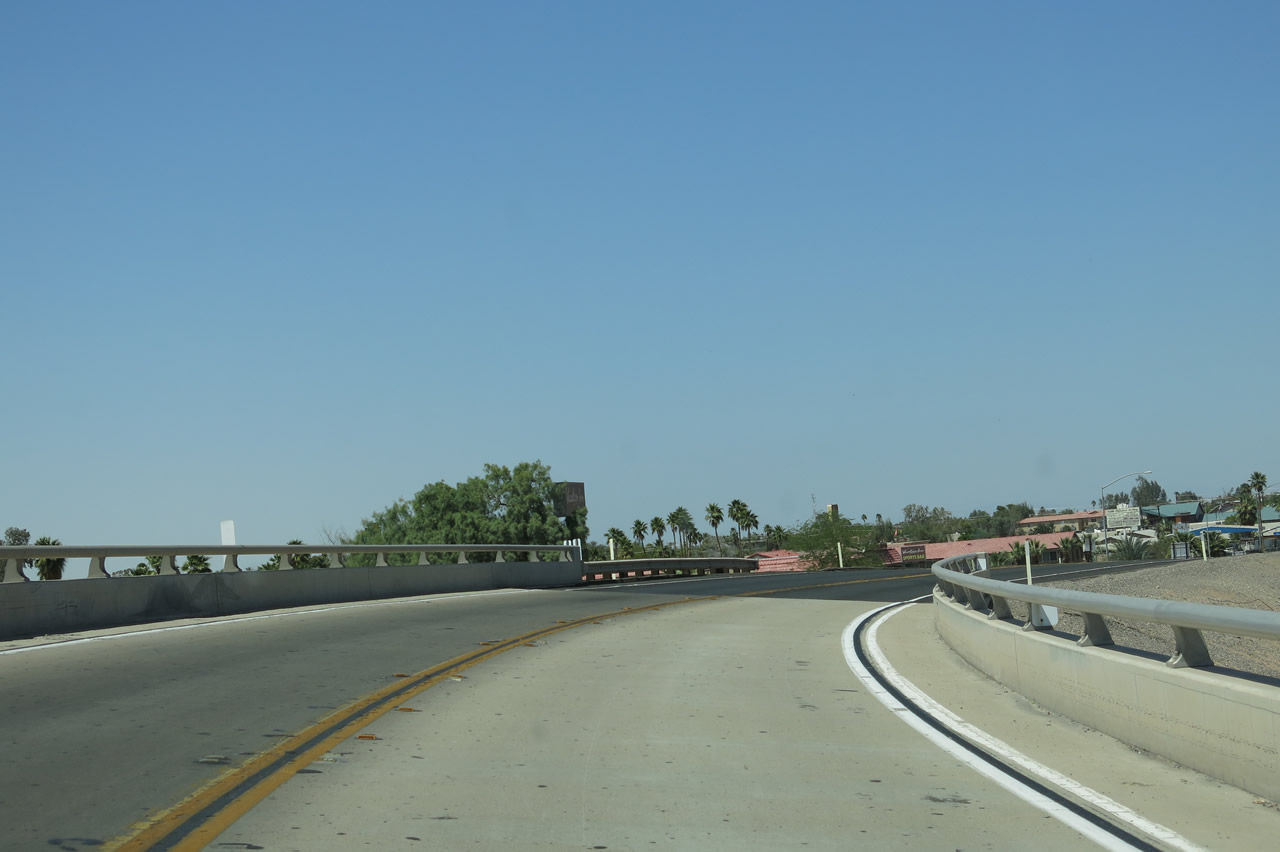
A flyover ramp carries westbound El Cajon Boulevard traffic over Interstate 8. Photos taken 10/08/10.
The ramp continues with two lanes westbound, culminating at the Baltimore Drive traffic signal in La Mesa. Turn left here for Spring Street and downtown La Mesa. Baltimore Drive also eventually connects with University Avenue westbound. Photos taken 10/08/10.
Westbound El Cajon Boulevard meets Baltimore Drive. Photo taken 10/08/10.
After passing by a shopping mall, U.S. 80/El Cajon Boulevard approaches Guava Avenue. Photo taken 10/08/10.
Turn left here for former Business U.S. 80/La Mesa Boulevard east to downtown La Mesa. Continue west on Historic U.S. 80/El Cajon Boulevard ahead for the College Area community of San Diego. At La Mesa Boulevard, the original alignment of U.S. 80 merges onto El Cajon Boulevard west. Once El Cajon Boulevard was constructed as a bypass route toward Grossmont Summit, U.S. 80 was transferred onto El Cajon Boulevard east of here, and La Mesa Boulevard became Business U.S. 80. Photo taken 10/08/10.
U.S. 80/El Cajon Boulevard and Business Loop I-8 west
The first Historic U.S. 80 sign is posted on westbound El Cajon Boulevard after the La Mesa Boulevard intersection in La Mesa. Historic U.S. 80 is also signed along La Mesa Boulevard through downtown La Mesa. Photo taken 10/08/10.
A landscape median lines El Cajon Boulevard between La Mesa Boulevard and Parks Avenue. An effort was made in the 1990s and 2000s to add landscaping to many sections of El Cajon Boulevard median that previously had none. Photo taken 10/08/10.
Westbound U.S. 80/El Cajon Boulevard (Business Loop I-8) meets Parks Avenue. No business loop shields are present anywhere along El Cajon Boulevard within the city limits of La Mesa, and only a few remain in San Diego as of 2010. Photo taken 10/08/10.
Historic U.S. 80 and Business Loop I-8 proceed west on El Cajon Boulevard in La Mesa. Photo taken 10/08/10.
Westbound Historic U.S. 80/El Cajon Boulevard meets Keeney Street. Photo taken 10/08/10.
Entering San Diego, Historic U.S. 80/El Cajon Boulevard approaches 73rd Street. Street names from here west through College Area, City Heights, North Park, and Hillcrest (via Washington Street) will descend numerically (with First Avenue in Hillcrest). Photo taken 10/08/10.
El Cajon Boulevard serves a variety of communities and neighborhoods on its route west. Initially it enters College Area, which is named for its proximity to San Diego State University (via Montezuma Road west). Photo taken 10/08/10.
Westbound El Cajon Boulevard meets 71st Street. Photo taken 10/08/10.
At this traffic signal, westbound El Cajon Boulevard meets 70th Street. Turn right (north) on 70th Street to the San Diego Trolley, Interstate 8, and Lake Murray Boulevard. Turn left (south) on 70th Street to University Avenue and Massachusetts Avenue south to Lemon Grove and California 94. Photo taken 10/08/10.
A few blocks west (after 67th Street), El Cajon Boulevard west meets Montezuma Road. Turn right (west) on Montezuma Road to San Diego State University and Interstate 8 (via the Fairmount Avenue-Mission Gorge Road interchange). Continue west on El Cajon Boulevard toward the College Area Business District, El Cerrito, Talmadge, and City Heights. Photo taken 10/08/10.
Westbound Business Loop I-8 and U.S. 80/El Cajon Boulevard enters the College Area Business District. Photo taken 10/08/10.
A short distance later, westbound Business Loop I-8 and U.S. 80/El Cajon Boulevard approaches Rolando Boulevard. Very few city streets in San Diego have as many billboards as El Cajon Boulevard. While new billboards are very rare in San Diego due to restrictive ordinances, older billboards remain in use and may owe their presence to the age of the boulevard as a major route into San Diego from the east. Photo taken 10/08/10.
This view looks west along Business Loop I-8 and U.S. 80/El Cajon Boulevard between Art Street and 63rd Street. Photo taken 10/08/10.
Westbound Business Loop I-8 and U.S. 80/El Cajon Boulevard meets 63rd Street. Photo taken 10/08/10.
One block west, Business Loop I-8 and U.S. 80/El Cajon Boulevard reaches 62nd Street. Photo taken 10/08/10.
A relatively new landscaped median lines El Cajon Boulevard between 62nd Street and College Avenue. Photo taken 10/08/10.
Westbound El Cajon Boulevard meets College Avenue. Turn left (south) to College Grove and California 94. Turn right (north) to San Diego State University, Interstate 8, and Del Cerro. Photo taken 10/08/10.
As of 2010, the first westbound Business Loop I-8 route marker is posted along westbound El Cajon Boulevard after College Avenue. Most of the shields on El Cajon Boulevard between 73rd Street and College Avenue that were in place in the mid-1990s were gone by 2007. It is likely that this sign will be gone in the coming years and not replaced. Photos taken 10/08/10 and 03/27/05.
Westbound Business Loop I-8 and U.S. 80/El Cajon Boulevard meets 59th Street and enters the neighborhood of El Cerrito. Photo taken 10/08/10.
Cresting after Alice Street, Business Loop I-8 and U.S. 80/El Cajon Boulevard has a nice view looking west. Photo taken 10/08/10.
Westbound Business Loop I-8 and U.S. 80/El Cajon Boulevard meets El Cerrito Drive. Photos taken 03/27/05 and 10/08/10.
Continuing west, Business Loop I-8 and U.S. 80/El Cajon Boulevard meets 56th Street. Photo taken 10/08/10.
Westbound Business Loop I-8 and U.S. 80/El Cajon Boulevard then meets 54th Street. Turn left on 54th Street south to Webster or turn right for 54th Street north to Collwood Boulevard to Montezuma Road and Interstate 8. Photo taken 10/08/10.
Another Business Loop I-8 shield is posted after 54th Street. Photo taken 10/08/10.
And right after the Business Loop I-8 shield is the first Historic U.S. 80 sign to be seen after leaving La Mesa. Photo taken 10/08/10.
Between 54th Street and Park Boulevard, El Cajon Boulevard has a teal (turquoise) color theme for its street lights and streetscape fixtures. From 54th Street and California 15, El Cajon Boulevard separates Colina Park and City Heights on the south from Talmadge and Kensington to the north. Photo taken 10/08/10.
Westbound Business Loop I-8 and U.S. 80/El Cajon Boulevard meets 52nd Street. Photo taken 10/08/10.
This view looks west along El Cajon Boulevard at Altadena Avenue. Photo taken 10/08/10.
Continuing west on U.S. 80/El Cajon Boulevard, we approach 48th Street. Photo taken 10/08/10.
Westbound U.S. 80/El Cajon Boulevard meets Euclid Avenue. Photo taken 10/08/10.
El Cajon Boulevard enters the Little Saigon district. Photo taken 10/08/10.
Westbound El Cajon Boulevard meets Menlo Avenue. A trailblazer sign for Interstate 8 and Interstate 15 is posted on the traffic signal mast arm. Photo taken 10/08/10.
Reaching Highland Avenue, westbound El Cajon Boulevard enters City Heights. North of the boulevard are Kensington (from here west to California 15) and Normal Heights (from there west to Interstate 805). To the south is City Heights. Photo taken 10/08/10.
Shortly thereafter, westbound El Cajon Boulevard meets Fairmount Avenue. This is a pivotal intersection, as Fairmount Avenue to the north of here used to carry U.S. 395 north toward the San Diego Mission and points north via Murphy Canyon. U.S. 395 has had three north-south alignments south of Miramar: originally, U.S. 395 paralleled today's Kearny Villa Road and Linda Vista Road southwest to end at U.S. 101 in the Morena District; later, U.S. 395 traveled south roughly along the Interstate 15 corridor via Murphy Canyon Road, Ward Road, and Fairmount Avenue to El Cajon Boulevard, then turned west on El Cajon Boulevard, south on Park Boulevard, and west on Market Street to end at U.S. 101/Harbor Drive in downtown San Diego; and finally along the Cabrillo Freeway (today's California 163) in its entirety, 10th/11th Avenue couplet, and Market Street. Note Pearson Ford in 2005, which has since closed and was demolished. Photos taken 10/08/10 and 03/27/05.
A Business Loop I-8 west reassurance shield is posted on westbound El Cajon Boulevard after the Fairmount Avenue intersection. Since this section of Fairmount Avenue is one-way northbound, U.S. 395 south will join El Cajon Boulevard at the next intersection (43rd Street). Photo taken 10/08/10.
Westbound El Cajon Boulevard reaches 43rd Street, which is one-way southbound. Ahead, U.S. 80 west and U.S. 395 south proceed toward North Park and Balboa Park. El Cajon Boulevard widens to six lanes (three in each direction) from here west to Park Boulevard in University Heights. Photo taken 10/08/10.
U.S. 80/El Cajon Boulevard and Business Loop I-8 west and U.S. 395 south
Another historic U.S. 80 route marker is posted shortly after 43rd Street next to Van Dyke Avenue. Unfortunately, Historic U.S. 395 is not jointly signed here (especially since El Cajon Boulevard is seen as synonymous with U.S. 80 but is not readily recognized as partially Historic U.S. 395). Photo taken 10/08/10.
The Boulevard Association placed many of the Historic U.S. 80 signs along El Cajon Boulevard, including this one at Van Dyke Avenue. Photo taken 10/08/10.
After passing by Copeland Avenue, westbound El Cajon Boulevard approaches its junction with California 15 (Future Interstate 15). The Boulevard Transit Plaza is situated on the El Cajon Boulevard bridge deck that spans over California 15. Adorned with decorative red arches and benches, the transit plaza will connect to future planned transit along California 15. Photo taken 10/08/10.
The next intersection is with Marlborough Avenue; follow Marlborough Avenue north to Kensington. Photo taken 10/08/10.
The interchange between El Cajon Boulevard and California 15/Escondido Freeway is a diamond interchange. The next right connects to Central Avenue and California 15 north, while the first left after crossing the bridge deck connects to California 15 south. Photo taken 10/08/10.
Red arches span on both sides of the bridge deck as we cross California 15. Stay left for the onramp to California 15 south. Photos taken 10/08/10.
Westbound U.S. 80-395/El Cajon Boulevard meets the onramp to California 15/Escondido Freeway south to Fairmount Park, Mount Hope, and 32nd Street Naval Station San Diego. Photo taken 10/08/10.
Leaving the California 15 interchange, we find another Historic U.S. 80 route marker. Photo taken 10/08/10.
Westbound Business Loop I-8 and U.S. 80-395/El Cajon Boulevard continue past 38th Street toward 37th Street (traffic signal in distance). Photo taken 10/08/10.
El Cajon Boulevard west meets 37th Street. Photo taken 10/08/10.
The Boulevard Business Association also posted teal banners advertising El Cajon Boulevard and welcoming people to "Cruise Historic Highway 80." Photo taken 10/08/10.
At 35th Street is the final westbound reassurance shield for Business Loop I-8, even though the route extends all the way to the California 163 and Washington Street interchange in Hillcrest. It is likely that remaining signs will be removed as they weather and fade without being replaced. Photo taken 10/08/10.
Westbound U.S. 80-395/El Cajon Boulevard meets 33rd Street. Photo taken 10/08/10.
At Interstate 805/Dekema Freeway, westbound U.S. 80-395/El Cajon Boulevard leaves City Heights and Normal Heights and enters North Park. Turn right here for Interstate 805 north to Mission Valley, University City, Sorrento Valley, and points north via Interstate 5. Stay left for the left turn to Interstate 805 south. Photo taken 10/08/10.
Entering North Park, westbound U.S. 80-395/El Cajon Boulevard meets the onramp to Interstate 805 south (left turn) to Southcrest, National City, Chula Vista, Otay Mesa, and San Ysidro. Photo taken 10/08/10.
Tall eucalyptus line both sides of El Cajon Boulevard in North Park. Ahead is the intersection with Illinois Street. Photo taken 10/08/10.
Crossing Ohio Street, the next traffic signal along El Cajon Boulevard westbound is with 30th Street, a major north-south corridor in North Park. The commercial core of North Park is a few blocks south along 30th Street, at its intersection with University Avenue. Photo taken 10/08/10.
After traffic signalized intersections with Utah Street and Oregon Street, El Cajon Boulevard proceeds downhill toward Texas Street, then uphill to Park Boulevard, which is the western terminus of El Cajon Boulevard. Photo taken 10/08/10.
Westbound El Cajon Boulevard meets Texas Street. Turn left for the municipal pool and Morley Field in Balboa Park. Turn right for Texas Street north into Mission Valley, meeting Interstate 8 and Qualcomm Way (Stadium Way). Photo taken 10/08/10.
After the Florida Street signalized intersection, westbound U.S. 80-395/El Cajon Boulevard passes under the Boulevard sign, which was erected in 1989 and welcomes eastbound travelers to the shopping and arts district along El Cajon Boulevard. Photo taken 10/08/10.
At Park Boulevard, El Cajon Boulevard ends. Turn left to follow U.S. 80 west and U.S. 395 south along Park Boulevard to Balboa Park and downtown San Diego. Continue straight ahead to follow Business Loop I-8/Normal Street southwest to Washington Street west to Uptown, which includes Hillcrest and Mission Hills. For a time, U.S. 80 continued west to California 163, then followed the Cabrillo Freeway south through Balboa Park to reach downtown (until the route was relocated to the Mission Valley Freeway, which is now Interstate 8). Turn right to follow Park Boulevard north into the University Heights business district. Photo taken 10/08/10.
Business Loop I-8/Normal Street and Historic U.S. 80 (1947-1953) west
Now we return to the intersection of El Cajon Boulevard, Park Boulevard, and Normal Street. After the Park Boulevard intersection, Business Loop I-8 and the 1947-1953 alignment of U.S. 80 continue southwest along Normal Street en route to the Cabrillo Freeway. U.S. 80 and Business Loop I-8 remain on Normal Street for only a few blocks; at Lincoln Avenue, it will turn west onto Washington Street. Photo taken 10/08/10.
A California 163 trailblazer shield is posted on southbound Normal Street as we approach the transition to westbound Washington Street. A Business Loop I-8 trailblazer was mounted above this California 163 until 2003, when many such route markers were removed along El Cajon Boulevard, Normal Street, and Washington Street. In fact, this was the placement for the final westbound route marker for the business route, with the implication that traffic wishing to "loop" back to Interstate 8 would take California 163/Cabrillo Freeway north. Photo taken 10/08/10.
U.S. 80 and Business Loop I-8 curve from Normal Street onto Washington Street at this traffic signal. Washington Street cuts between the neighborhoods of Hillcrest and University Heights. Photo taken 10/08/10.
Business Loop I-8/Washington Street and Historic U.S. 80 (1947-1953) west
Passing south of University Heights and north of Hillcrest, westbound Washington Street (Former Business Loop I-8 and briefly historic U.S. 80) meets Cleveland Avenue at this traffic signal. Ahead is the junction with California 163/Cabrillo Freeway (former U.S. 395); use the right lanes to transition onto either direction of the freeway. Photo taken 08/17/08.
Westbound Washington Street (Former Business Loop I-8 and briefly historic U.S. 80) meets Lincoln Avenue at this traffic signal. Use the right two lanes to connect to California 163. Photo taken 08/17/08.
As the right two lanes split from Washington Street to California 163, the left lanes continue west toward Hillcrest. Photo taken 08/17/08.
The left lane of the transition ramp connects to California 163/Cabrillo Freeway south to downtown San Diego, while the right lane connects to California 163/Cabrillo Freeway north to Mission Valley, Linda Vista, Clairemont, and Kearny Mesa before merging with Interstate 15 near Miramar. Photo taken 08/17/08.
The Vermont Street pedestrian bridge crosses over Washington Street and the transition ramp to California 163. Built in 1995, the Vermont Street Bridge replaced an earlier wooden trestle bridge that was in service from 1916 until 1978 (demolished in 1979 due to rotting conditions). The pedestrian bridge links the neighborhoods of University Heights with Hillcrest. Photo taken 08/17/08.
The two directions of California 163 split at this gore point. While U.S. 80 was still routed along El Cajon Boulevard in the late 1940s and the Cabrillo Freeway was complete, this transition ramp served as part of transcontinental U.S. 80 before the federal highway turned south toward downtown via the freeway. Once U.S. 80 was relocated to the Mission Valley Freeway (now Interstate 8), old U.S. 80 became Business U.S. 80, and that eventually became Business Loop I-8. The business loop remained signed until the early 2000s; signs for the business loop along most of Washington Street and El Cajon Boulevard were removed by 2003. The California 163 interchange with Washington Street marks the western terminus of Business Loop I-8. Photo taken 08/17/08.
Scenes Pertaining to Business Loop I-8 in San Diego and La Mesa
This new-style city of San Diego street sign marks the intersection of El Cajon Boulevard and Esther Street in San Diego. These signs are being phased in across the city through 2020. Photo taken 03/27/05.

Business Loop 8 - El Cajon

Business Loop I-8/El Cajon Boulevard (U.S. 80) east
Now on the offramp to Exit 15, the right lane will depart to Chase Avenue, while the left two lanes continue east on Business Loop I-8/El Cajon Boulevard toward El Cajon Boulevard. Photo taken 11/06/04.
The first business route shield is posted on the offramp from El Cajon Boulevard east to Chase Avenue. This shield is presumably posted here to remind motorists to continue straight ahead to merge back onto Business Loop I-8/El Cajon Boulevard (Old U.S. 80) east to downtown El Cajon. Photo taken 02/07/05.
This is the first shield found along eastbound Business Loop I-8 in the city of El Cajon, immediately after exiting the Interstate 8 freeway. The shield was installed in 2002. Photos taken 11/06/04 and 10/12/03.
Business Loop I-8/Main Street (U.S. 80) east
Passing through downtown El Cajon, Business Loop I-8/Main Street (Old U.S. 80) has white painted traffic signals such as this one located at Sunshine. Photo taken 02/07/05.
Eastbound Business Loop I-8/El Cajon Boulevard (Old U.S. 80) meets Old California 67/Magnolia Avenue at this intersection. Turn left here to follow Magnolia Avenue north to California 67 north to Santee, Lakeside, and Ramona. Photo taken 02/07/05.
Business Loop I-8/Business Route 8 (U.S. 80) east
Business Loop I-8/Business Route 8 (U.S. 80) west
Business Loop I-8/Main Street (U.S. 80) west
This reassurance shield for Business Loop I-8 west is posted prior to the Interstate 8 bridge northeast of downtown El Cajon. Photo taken 02/07/05.
Business Loop I-8/El Cajon Boulevard (U.S. 80) west

Business Loop 8 - Alpine

Business Loop I-8 and U.S. 80/Alpine Boulevard east
Business Loop I-8 and U.S. 80/Alpine Boulevard west

Business Loop 8 - El Centro

Business Loop I-8 east and Imperial Avenue north
Business Loop I-8, Historic U.S. 80, Imperial County Route S-80/Adams Avenue east and California 86 and Historic U.S. 99 south
Business Loop I-8 east and California 86/Fourth Street and Historic U.S. 99 south
Business Loop I-8 west and California 86/Fourth Street and Historic U.S. 99 north
Business Loop I-8, Historic U.S. 80, Imperial County Route S-80/Adams Avenue west and California 86 and Historic U.S. 99 north
Business Loop I-8 west and Imperial Avenue south

Business Loop 8 - Winterhaven and Yuma

Business Loop I-8 and U.S. 80/Winterhaven Drive east
Traveling east on Business Loop I-8 (Winterhaven Drive), this is the first mainline reassurance shield after the business loop merges with Old U.S. 80/Araz Road. From here, Business Loop I-8 and U.S. 80 travel east together toward Winterhaven. Some maps also sign this road as part of Imperial County Route S-24, but the county route shields do not appear until the Picacho Road intersection. Photo taken 01/15/07.
Palms block the view south into a recreational vehicle long-term visitors area. Photo taken 01/15/07.
Another Business Loop I-8 shield is posted as downtown Winterhaven comes into view. This unincorporated community of Imperial County is located on old U.S. 80 and sits at an elevation of 130 feet above sea level. The 2000 Census places the population at 529 people, which certainly increased during the winter months. Photo taken 01/15/07.
Welcome to downtown Winterhanven. While the long-distance traveler amenities formerly common due to U.S. 80 (such as gas stations) are not found here, other businesses thrive, especially during the winter. Photos taken 01/15/07.
Leaving downtown Winterhaven, Business Loop I-8 and U.S. 80 widen out to four lanes with a median divide. Photo taken 01/15/07.
The next major intersection on Business Loop I-8 is with Imperial County Route S-24, which travels northeast toward the Laguna and Imperial Dams via the Quechan (Fort Yuma) Indian Reservation and Bard. Photo taken 01/15/07.
The first advance sign provides the mileage to Bard (seven miles), Laguna Dam (13 miles), and Imperial Dam (18 miles) via Imperial County Route S-24/Picacho Road. Photo taken 01/15/07.
Use Imperial County Route S-24/Picacho Road north to the Picacho State Recreation Area along the Colorado River near Picacho Peak. At the point where Imperial County Route S-24 turns east along Ross Road, continue north on Picacho Road (which turns into an unimproved roadway) all the way to the river. Photo taken 01/15/07.
Eastbound Business Loop I-8 meets Imperial County Route S-24 at this four-way stop sign. Turn left to follow Imperial County Route S-24 north to Bard and the dams along the Colorado River; continue straight ahead (now south) to follow Business Loop I-8 and U.S. 80 east to Interstate 8 (at Exit 172) and Yuma, Arizona. Use Imperial County Route S-24 north to the Quechan Casino and the Ocean-to-Ocean Highway Bridge, which was the first to carry U.S. 80 into Arizona. Photo taken 01/15/07.
Business Loop I-8 and U.S. 80/Winterhaven Drive west

Page Updated June 18, 2011.