California 905

Return to AARoads


Site Navigation
Baja California
California
Colorado
Idaho
Hawaii
Nevada
New Mexico
Oregon
Utah
Washington
Wyoming


California 905

Routing

California 905 is the east-west connector between Interstate 5 near San Ysidro and the Otay Mesa Port of Entry (POE). California 905 is completely signed for its entire constructed length, including the temporary expressway section between Interstate 805 and site of the future California 125/905 interchange. California 905 can be divided into four segments:

  • Segment One - The unconstructed section between the International Border near Border Field State Park - this segment passes through some environmentally sensitive areas and will likely never be constructed.
  • Segement Two - Between the Interstate 5/California 905 junction and one-half mile east of the Interstate 805/California 905 junction; this is the only complete freeway section.
  • Segment Three - The temporary expressway portion between one-half mile east of Interstate 805 and the future California 125 junction. This segment will be replaced by a freeway scheduled to open between 2006 and 2008.
  • Segment Four - The conventional multi-lane divided (not freeway) section between the future California 125 junction and the Otay Mesa border crossing and Port of Entry.

For information on the progress of constructing the middle segment of 905 freeway, visit the San Diego Association of Governments (SANDAG) State Route 905 web page.

History

  • 1975 - California 117 freeway under construction between Interstate 5 and Interstate 805. Plans call for the freeway to continue eastward to the Otay Mesa Port of Entry.
  • 1984 - California 905 commissioned to replace California 117, which was previously part of California 75. Designation is changed to reflect future plans to add California 905 into the Interstate Highway System. Since Otay Mesa Road between I-805 and the future California 11-125 interchange is not maintained by Caltrans, this section is not signed as California 905.
  • 1997-1999 - The City of San Diego widens the existing Otay Mesa Road as a stop-gap measure until the full freeway is built parallel to and south of Otay Mesa Road. After this construction is completed, Otay Mesa Road will be maintained by the state until after the freeway is constructed in the new century.
  • 1998 - California 905 included in High Priority Corridor 30 in the hopes the designation would bring additional funding for the upgraded border crossing and freeway.
  • 1999 - Initial Environmental Impact Reports were completed for the future 905 freeway; final documents were completed five years later.
  • Spring 2000 - Work is completed on interim, temporary California 905 expressway along Otay Mesa Road between Old Otay Mesa Road just east of Interstate 805 to the future California 11-125 freeway interchange. This new expressway is built to Caltrans standards, with six lanes, Botts Dots, standard signage, and a special fence-like median strip to prevent pedestrians from attempting to cross the highway. Signalized intersections with protected left turns are installed at Heritage/Otay Valley Road, Cactus Road, Britannia Boulevard, Alisa Court, La Media Road, and Otay Mesa Road near the future California 125 interchange/connector. Planning continues for a permanent Interstate 905 freeway south but parallel to the existing California 905 expressway. Traffic continues to escalate as all trucks must use the Otay Mesa Border Crossing. The freeway segment is planned to begin between 2000 and 2004, according to the 2000 SANDAG Regional Transportation Plan.
  • September 2004 - Final Environmental Impact Statement approved for the remainder of the freeway construction project.
  • Spring 2005 - The California 905 interchange with Siempre Viva Road was completed and opened to traffic.
  • 2006 - the total project cost to complete California 905 is $670 million; of this amount, $348 million was identified by early 2008.
  • 2007 - Due to funding shortfalls, the project to finish California 905 is divided into two phases: Phase 1A is the eastern segment of 905 from Siempre Viva Road to Britannia Boulevard, and Phase 1B is the western segment from Britannia Boulevard to just east of Interstate 805.
  • January 2008 - Construction began on Phase 1A, from Siempre Viva Road to Britannia Boulevard. Final completion of Phase 1A is likely in 2010, and since Phase 1B is not funded as of this writing, it will take longer to construct.

Guide

Prior to Spring 2000, California 905 existed in two segments. One was the freeway segment between Interstate 5/Tocayo Road and 1/2 mile east of Interstate 805, and the other was the multi-lane conventional highway between the future California 125 interchange and the Otay Mesa Port of Entry. During that time, the City of San Diego maintained Otay Mesa Road between the two segments of state highway.

In an agreement inked between the City of San Diego and Caltrans from 1998, the City would pay to upgrade Otay Mesa Road to six lanes with turning lanes by the end of 1999, and Caltrans would maintain the road as a state facility until the California 905 freeway is built. Construction was completed in early 2000, and signs for California 905 were erected shortly thereafter.

Planning continues for the future California 905 freeway between one-half mile east of Interstate 805 and the future California 11-125 junction. Plans call for a six-lane freeway that will remove international truck and vacation traffic from Otay Mesa Road. Early estimates indicate that this road will cost $220 million, but they were raised to $255 million in 2000. Plans called for project to begin prior to 2004, but the lack of funding slowed progress. SANDAG forecasts call for an average of 70,000 to 100,000 vehicles to use the road per day once it is built.

Once the California 905 freeway is constructed, it will be redesignated as Interstate 905, per an agreement between the FHWA, Caltrans, and SANDAG. California 905 was approved as Interstate mileage in 1984, but it will be signed as an Interstate highway after the freeway is complete.

A Temporary Solution to Filling the California 905 Gap

The controversy surrounding California 905 is the completion of the missing freeway link of Segment Three. City of San Diego officials constructed the interim expressway as a temporary fix to close the gap. The original Otay Mesa Road was an under-developed City street that became California's busiest trade route with Mexico. People wanted Otay Mesa Road upgraded to expressway or freeway status for several reasons:

  • The road was designed for a maximum of 35,000 vehicles a day, but traffic often exceeds 50,000 vehicles.
  • Since 1990, 25 people have been killed and 350 others injured on the five-mile eastern stretch of Otay Mesa Road that runs just south of the Brown Field cargo airport and across rolling hills, between Interstate 805 and the Mexican border.
  • The Federal Government opened the Otay Mesa Port of Entry, approved the North American Free Trade Agreement (NAFTA), and shifted all cross-border truck traffic onto the road in a span of fifteen years. Prior to these actions, Otay Mesa Road only handled 4,300 vehicles per day.

As a short-term solution (in lieu of a full freeway), the City of San Diego and Caltrans appropriated $17 million in Fiscal Year 1998 to widen Otay Mesa Road to three lanes each way, add a concrete median, and widen the shoulders. This was approved in December of 1994. The City and Caltrans hoped to begin work immediately thereafter (in 1995), but an Environmental Impact Study was required. Construction did not begin until August 1997, and it was delayed at several points. It was completed by late 1999/early 2000.

By 2015, it is expected that the widened and improved California 905/Otay Mesa Road expressway will be inadequate for the demands placed on that road, so Caltrans is planning for a freeway-grade road to be constructed by 2004.

Reasons to Build the California 905 Freeway

Meanwhile, local politicians are working to secure money to build the future California 905 freeway, which would parallel the existing Otay Mesa Road and provide six- to eight-lanes of traffic between Interstate 805 and California 125. Former San Diego Mayor Susan Golding said federal funding is sorely needed to extend California 905 to the Otay Mesa border crossing in the mid-1990s. In August 1997, U.S. Representative (Pa.) Bud Shuster, chairman of the House Transportation Committee, visited the border region and pledged to help secure money to complete the California 905 freeway. Route 905 was listed as a High Priority Corridor in BESTEA, the House-approved ISTEA Reauthorization bill, and it was finally added to the final TEA-21 bill signed into law in 1998.

Funding for the California 905 freeway has been difficult to obtain. In the mid-1990s, state and federal officials weren't even sure whether to build a $130 million four-lane expressway or a $255 million six-lane freeway (figures as of 2000 SANDAG Regional Transportation Plan). The feasibility study and Major Investment Study for the 905 freeway was completed in spring 1998, and the Environmental Impact Study was made public in 1999. Upon completion, California 905 will be designated as Interstate 905, as part of an obligation that is included in an agreement between the FHWA and the State of California.

However, decisions have since been made that have already completed the expressway, and a freeway plan has been approved for four key reasons:

  • Otay Mesa POE. The only border crossing trucks may use in southwestern San Diego County is the Otay Mesa crossing. The San Ysidro (Interstate 5/805) POE prohibits trucks. There are signs telling truckers to take California 905 to cross the border. Otay Mesa Road's congestion is caused by a higher than expected accident rate as a result of trucks having to use the Otay Mesa POE to enter and exit Mexico. Compounding the problem is the relatively high rate of trucks (16% is considered high for a city street). The increased truck traffic on an inadequate road impedes border access.
  • Industrial Area. Otay Mesa is a primarily industrial area. Widening Otay Mesa Road to six lanes is a temporary solution with short-term relief. A full freeway is needed to handle maquiladora traffic and increased commercial activity projected in the Otay Mesa area. Right across the border, Mexican maquiladoras are churning out all kinds of products that are shipped to the U.S. and other countries. Currently the trucks serving those factories must use the Otay Mesa POE or go to the Tecate (California 188) or Calexico (California 7) crossings via the Mexican 2-D Cuota (Toll Road). Mexico Route 2-D is the Mexican toll road that parallels the border between Tijuana and Mexicali. It is the Mexican equivalent of Interstate 8, except Interstate 8 is free of tolls.
  • NAFTA. Officials expect a sharp increase in truck traffic due to the North American Free Trade Agreement, or NAFTA. They see commerce between the two countries increasing dramatically "as the barriers come down." Average daily traffic is currently 44,000 vehicles per day; it is expected to rise to 68,000 by 2020. Border crossings at Otay Mesa are expected to triple during that period, to 85,000 crossings in 2005 and 230,000 crossings in 2020.
  • Brown Field. The Brown Field airport is located along Route 905 just west of the Otay Mesa POE. This is important because the airport is being expanded, with plans to dramatically increase its cargo load. As Lindbergh Field (San Diego International Airport) gets busier and busier, Brown Field has picked up a lot of the slack. I would not be surprised if Brown Field ends up with quite a bit of the cargo load after the expansion is complete, because Lindbergh is too busy as it is. Many seem to think that Otay Mesa would be a great place to build a replacement airport should planners decide Lindbergh is not big enough to accommodate the increasing passenger air traffic. This idea of a border-area airport is not new. "TwinPorts," a proposal that proposed a major binational airport with around 400 passenger flights a day, was advocated in the 1980s, but the Brown Field proposal does not include additional passenger flights.

In conclusion, California 905 is considered necessary both for a current safety need and also for a future transportation need. It is part of an intermodal plan for the border region -- the planned San Diego and Imperial Valley Railroad (SD&IV) is supposed to have a link directly to the Otay Mesa area, including Brown Field. It's a great setup for an TEA-21 intermodal facility.

California 905/Otay Mesa Freeway east
After the Oro Vista Road intersection, eastbound California 905 begins its freeway configuration. The first offramp connects to Interstate 5 south, followed by a loop ramp to Interstate 5 north. Photo taken 08/21/04.
Eastbound California 905/Otay Mesa Freeway reaches Exit 0B, Junction Interstate 5 north to Chula Vista, National City, San Diego, and points north. The pull-through sign, which should say "California 905 east," instead reads "Otay Mesa Road." Photo taken 08/21/04.
A pair of freeway entrance shields flank the transition ramp to Interstate 5 north. Photo taken 08/21/04.
The first standalone exit along California 905 east after the Interstate 5 interchange is Exit 1, Beyer Boulevard. Beyer Boulevard, which parallels Interstate 5, is the original alignment of U.S. 101 through the San Ysidro and Otay Mesa-Nestor communities in south San Diego. Photo taken 08/21/04.
The truck border crossing is nine miles east of here. Follow California 905 east to La Media Road south to the truck crossing queue. Photo taken 08/21/04.
Eastbound California 905/Otay Mesa Freeway reaches Exit 1, Beyer Boulevard. The next exit is Exit 2A, Picador Boulevard/Smythe Avenue. Photo taken 08/21/04.
This mileage sign provides the distance to the next two exits along California 905/Otay Mesa Freeway east: Exit 2A, Picador Boulevard/Smythe Avenue and Exit 2B, Junction Interstate 805/Dekema (Inland) Freeway. Photo taken 08/21/04.
Eastbound California 905 reaches Exit 2A, Picador Boulevard/Smythe Avenue. Near this interchange are the "Cuidado" (Warning) signs for pedestrians running across the freeway. Similar signs are placed on Interstate 5 near the San Ysidro Port of Entry as well as at the Border Patrol Checkpoint within Camp Pendleton between the Las Pulgas Road and Gunnery Sergeant John Basilone Road exits near San Onofre. Because of their popularity, these yellow signs are frequently the target of theft. Photo taken 08/21/04.
The next exit along California 905 east is Exit 2B, Junction Interstate 805/Inland Freeway. Use Interstate 805 north to Chula Vista, Bonita, National City, and the city of San Diego communities of City Heights, Mission Valley, Serra Mesa, Clairemont, University City, and Sorrento Valley. Photo taken 08/21/04.
Eastbound California 905/Otay Mesa Freeway reaches Exit 2B, Junction Interstate 805. Photo taken 08/21/04.
A "RAMP" gore point sign signifies the transition from California 905 to Interstate 805. Photo taken 08/21/04.
The transition ramp splits, with the right lane departing for Interstate 805 south to San Ysidro and the international border crossing with Mexico. Continue straight ahead to Interstate 805 north to eastern Chula Vista, National City, and San Diego. Photo taken 08/21/04.
After the Interstate 805 interchange, this sign advises that the Otay Mesa Port of Entry and truck crossing is seven miles east of here. Due to the lack of truck facilities at the Interstate 5 San Ysidro Border Crossing, truck traffic on California 905 is very high. Photo taken 12/03/06.
An older California 905 east reassurance shield is posted shortly thereafter. Photo taken 12/03/06.
Currently, the Otay Mesa Freeway ends in one-half mile. An ongoing freeway construction project will see completion of the California 905 freeway in Photo taken 12/03/06.
The speed limit on California 905 east reduces to 50 miles per hour as the freeway ascends Otay Mesa. The next traffic signal is with Otay Mesa Road, which travels southwest toward San Ysidro. Photo taken 12/03/06.
California 905/Otay Mesa Road east
Continuing east after the Otay Mesa Road intersection, eastbound California 905 widens to three lanes in each direction and has traffic signals at approximately one-half mile increments. This expressway can be very dangerous due to high truck volume and sudden stops. Watch for pedestrians and stopped vehicles. A chain link fence serves as the initial median barrier. Photo taken 12/03/06.
At the top of the hill is a right turnoff for Old Otay Mesa Road, which travels south and then west to the Princess Park and Remington Hills subdivisions. Access to this road is only available from California 905 east. When California 905's freeway is built, the plan is to run it onto a new alignment from around this point east to the California 125 interchange. The new freeway will parallel existing Otay Mesa Road on an alignment about a quarter mile south. Photo taken 08/21/04.
The first traffic signal on California 905/Otay Mesa Road east is with Caliente Avenue south and Ocean View Hills Parkway north. At the time this picture was taken, there was no access onto Ocean View Hills Parkway, but that connection opened in 2007 and now serves the Ocean View Hills neighborhood north of the highway. Turn right onto Caliente Avenue south to San Ysidro High School. Further development is planned south of here, and Caliente Avenue will serve as a connection to that new development as it is built. Photo taken 08/21/04.
Eastbound California 905/Otay Mesa Road meets Caliente Avenue south and Ocean View Hills Parkway north. Photo taken 08/21/04.
The next traffic signal on California 905/Otay Mesa Road east is with Corporate Center Drive, which serves several business parks north of the highway. Photo taken 08/21/04.
Eastbound California 905/Otay Mesa Road approaches Heritage Road. Use Heritage Road south to business park areas and north to Otay Valley Road en route to the city of Chula Vista (Otay Valley Regional Park, amphitheatre, and water slide park). Photo taken 08/21/04.
Eastbound California 905/Otay Mesa Road meets Heritage Road. Photo taken 08/21/04.
The next traffic signal on California 905/Otay Mesa Road east is with Cactus Road south and Balchen Way north. Cactus Road, like other nearby business parks, serves the maquiladora facilities that have ties to manufacturing operations in Mexico. Photo taken 08/21/04.
Eastbound California 905/Otay Mesa Road meets Cactus Road at this traffic signal. Brown Field and its sprawling runway comes into view on the north side of Otay Mesa Road. Photo taken 08/21/04.
Even though we are traveling due east, a "South California 905" shield is posted along Otay Mesa Road after the Cactus Road intersection. Photo taken 08/21/04.
The next traffic signal on California 905/Otay Mesa Road east is with Britannia Boulevard. Photo taken 08/21/04.
Another California 905 south reassurance shield is posted on eastbound Otay Mesa Road after the Britannia Boulevard intersection. Photo taken 08/21/04.
The next traffic signal on California 905/Otay Mesa Road east is with Gailes Boulevard. Photo taken 08/21/04.
With Otay Mountain serving as the dramatic background, a median sign for Aisla Boulevard is posted on eastbound California 905/Otay Mesa Road. Photo taken 08/21/04.
After passing by Ocean View Hills and Brown Field Municipal Airport, eastbound California 905 approaches Otay Mesa Center Road. Photo taken 12/03/06.
All trucks with cargo entering Mexican must use Otay Mesa Road (California 905) east to La Media Road south. Photo taken 12/03/06.
A second sign for trucks is posted after Otay Mesa Center Road. All trucks crossing the international border must use La Media Road south. Photo taken 08/21/04.
A long queue is provided in the number four lane for trucks turning onto La Media Road south along eastbound California 905/Otay Mesa Road. Photo taken 08/21/04.
Eastbound California 905/Otay Mesa Road meets La Media Road at this traffic signal. Turn right at this traffic signal to the truck port of entry to Mexico. Photo taken 12/03/06.
About a half-mile east, California 905 meets Piper Ranch Road at this traffic signal. To the headquarters of the South Bay Expressway (Toll California 125), turn left at this signal. Photo taken 12/03/06.
At the time this photo was taken, the temporary intersection between California 905 and California 125 was still under construction. By December 2007, this intersection was fully functional and now looks much different than shown here. Photo taken 12/03/06.
Prior to completion of the California 125/South Bay Expressway toll road, this sign advised of destinations along Otay Mesa Road east toward the R.J. Donovan State Prison. Photo taken 08/21/04.
A California 905 south reassurance shield is posted after the intersection with California 125/South Bay Expressway and prior to the Otay Mesa Road split. Photo taken 12/03/06.
As California 905 turns south, Otay Mesa Road turns east toward the R.J. Donovan Correctional Facility and George Bailey Detention Center. Continue straight ahead to Siempre Viva Road and Otay Mesa Port of Entry. Photos taken 08/21/04 and 12/03/06.
California 905/Paseo Internacional south
Between California 125 and the international border with Mexico, California 905 is known as Paseo Internacional and travels due south toward the port of entry. This sign advising of construction was posted south of the Otay Mesa Road intersection. The freeway segment through the Otay International development was completed in 2004-2005. Photo taken 08/21/04.
A California 905 south reassurance shield is posted shortly thereafter. At least now the state highway is indeed traveling south. Photo taken 08/21/04.
Southbound California 905 approaches an intersection with Airway Road. Around this point, the Otay Mesa Freeway will eventually tie into California 905's existing alignment and then connect with the completed freeway segment from here south to the international border port of entry. A roadside sign advises of the pending border crossing. All trucks must exit onto Siempre Viva Road west; only passenger vehicles may use California 905 south to cross into Mexico. Photo taken 08/21/04.
After Airway Road, California 905 assumes freeway characteristics for the final mile before entering Mexico. This sign warns that guns and ammunition are illegal in Mexico, and possession of same may result in severe penalties and incarceration. Photo taken 08/21/04.
The new freeway construction was evident in this series of 2004 photos; the bridge and exit for Siempre Viva Road were completed by 2005. Photo taken 08/21/04.
After the interchange, southbound California 905 used to meet Siempre Viva Road at this traffic signal. This signal was removed in 2005 with the completion of the short freeway segment here. Photo taken 08/21/04.
Southbound California 905 used to meet Siempre Viva Road at this traffic signal. Photo taken 08/21/04.
A final U-turn is offered for motorists before the entrance into the federal port of entry which allows crossing the international border into Mexico. Photo taken 08/21/04.
At the final U-turn, Caltrans maintenance ends, yet there is no END shield for California 905. Upon crossing into Mexico, motorists enter the city of Tijuana. With a population of 1,483,992 (estimate as of 2009), the city of Tijuana ("¡Tienes que Vivirla!" - "You Have to Live It!") has more people living in it than the neighboring city of San Diego. Tijuana was founded and established on July 11, 1889. The economy has grown tremendously as a result of tourism, maquiladoras, manufacturing, NAFTA-related trade, and migration to areas close to the U.S.-Mexico border. For travelers on California 905 south: Once in Tijuana, motorists can follow the signs to Tijuana International Airport (Rodriguez Field), downtown Tijuana, the Tijuana Beltway (Tijuana Dos Mil or Tijuana 2000), the Scenic Coast Highway (Mexico Federal Route 1) south to Rosarito and Ensenada, and Mexico Federal Route 2 east to Tecate and Mexicali. Photo taken 08/21/04.

California 905/Otay Mesa Freeway north
California 905/Otay Mesa Road west
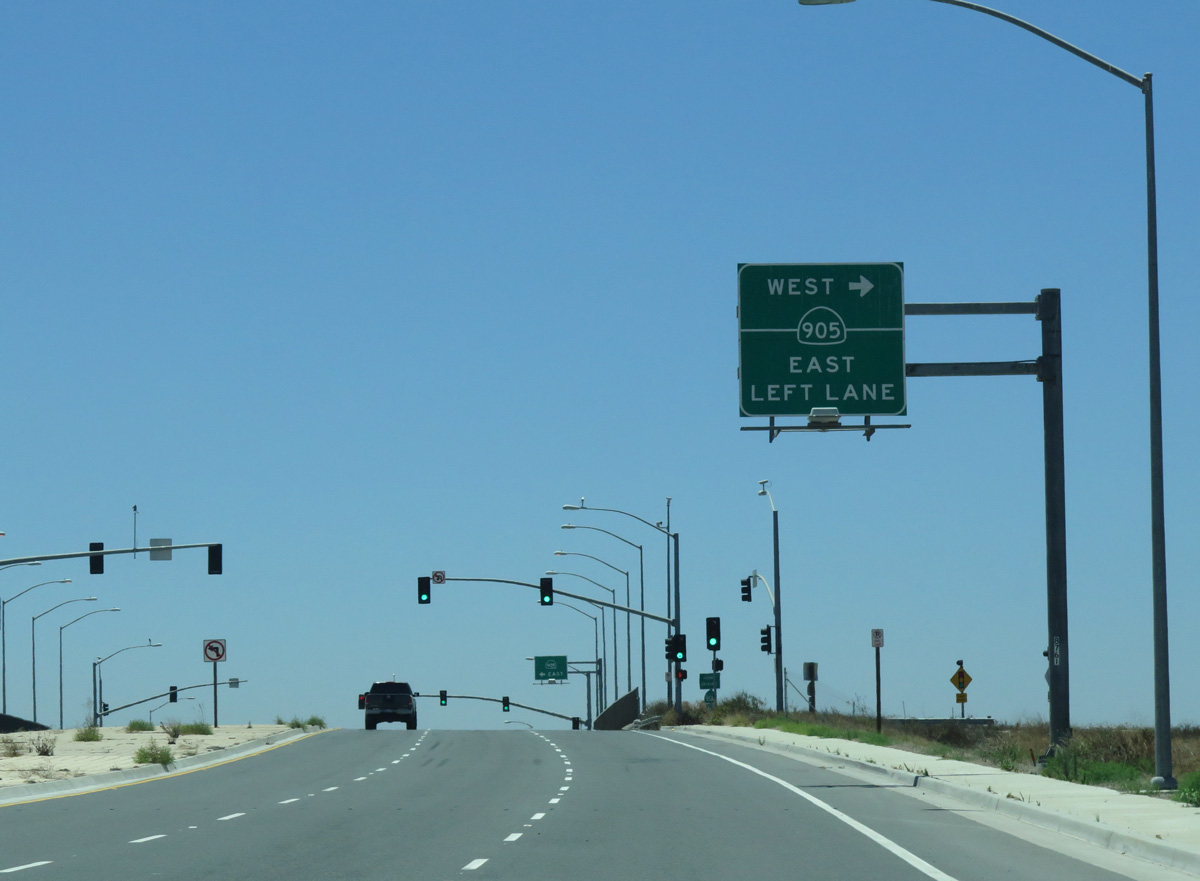
After the brief freeway segment near Siempre Viva Road comes to its temporary end, a California 905 north reassurance shield is posted prior to the intersection with California 125/South Bay Expressway. At the time this photo was taken, the toll road was still under construction. By December 2007, this intersection was fully functional and now looks much different than shown here. Photo taken 12/03/06.
California 905/Otay Mesa Freeway east
Westbound California 905 reachse Exit 2B, Junction Interstate 805 along the transition ramp. This kind of sign is generally not used for freeway-to-freeway connections, so it is a bit substandard. Photo taken 12/15/02.
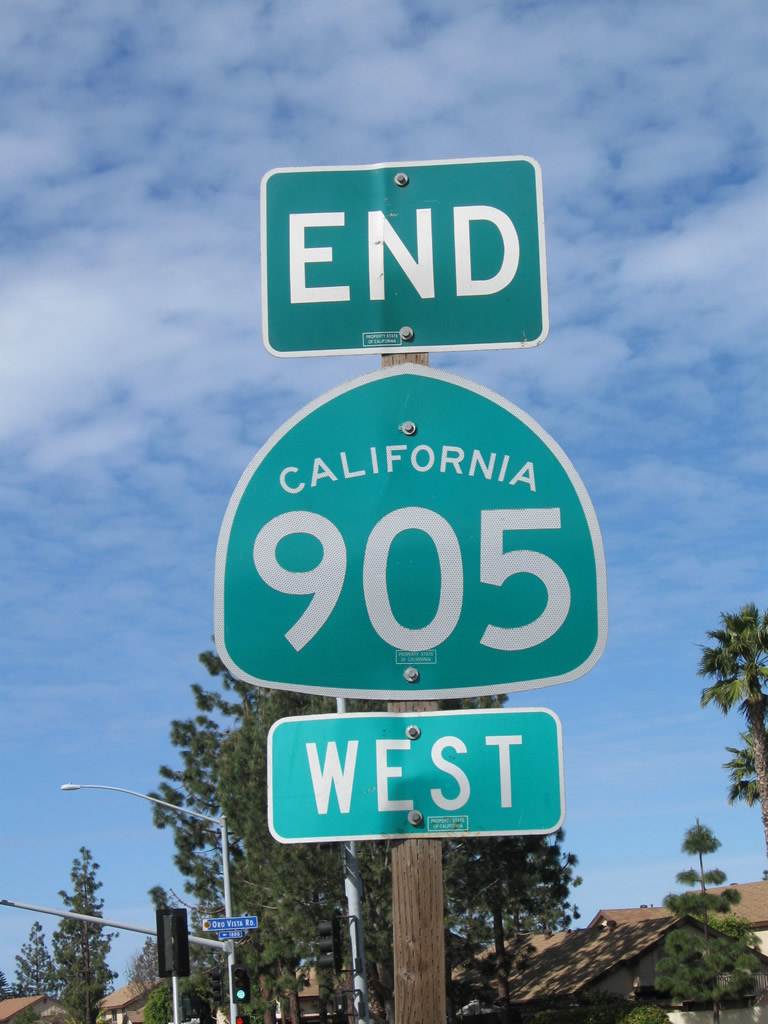
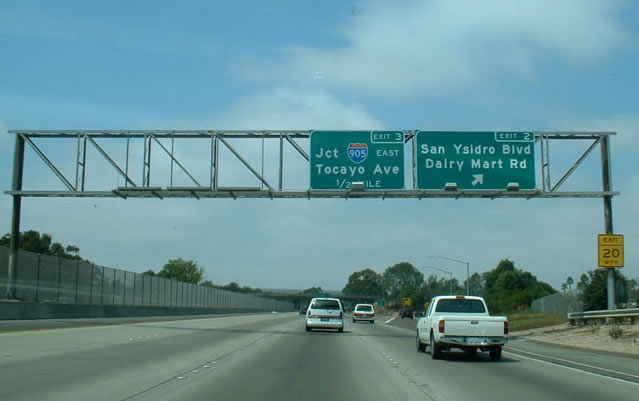
The next exit along California 905 west is Exit 1C, Beyer Boulevard, one-half mile. The following exit is Exit 1B, Junction Interstate 5 south, Tocayo Avenue, and Oro Vista Road. The final exit is Exit 1A, Junction Interstate 5 north. Photo taken 09/06/03.
Westbound California 905/Otay Mesa Freeway reaches Exit 1C, Beyer Boulevard. Photo taken 09/06/03.
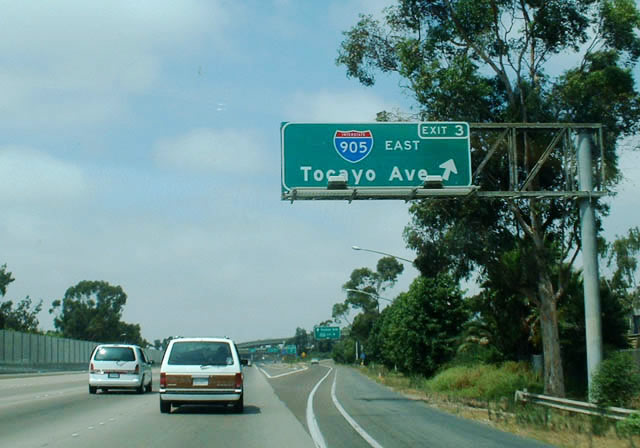
Immediately thereafter, westbound California 905 reaches Exit 1B, Interstate 5 south and Oro Vista Road/Tocayo Avenue. Photo taken 09/06/03.
Scenes Pertaining to California 905

Back to Interstate 880 Return to the California Gateway Continue to Interstate 980

Page Updated May 23, 2009.